
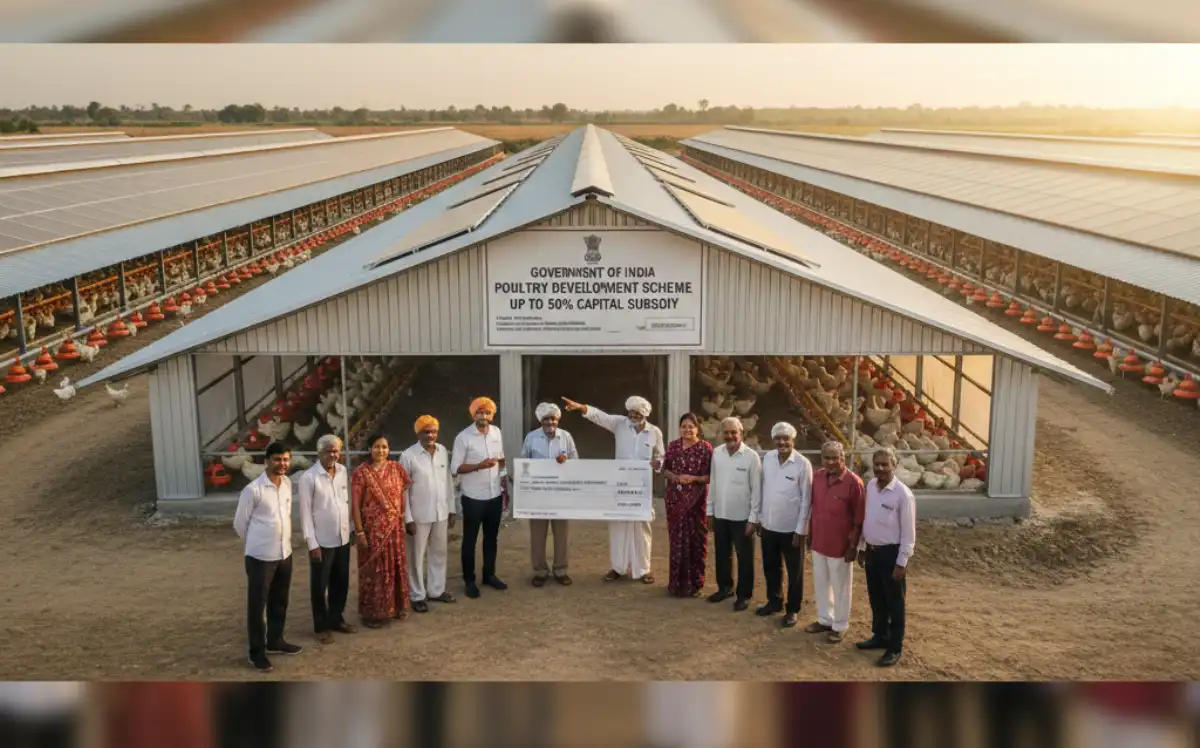
Are you dreaming of starting your own poultry farm but feel held back by the high costs of sheds, equipment, and birds? What if the government could cover up to half of your investment?
You read that right. To boost food security and rural entrepreneurship, the Indian government is rolling out substantial subsidies—from 25% to 50%—for new and existing poultry farmers in 2025. This isn’t just a loan; it’s direct financial aid to lift a major burden off your shoulders.
Whether you’re a small-scale farmer or a budding agri-entrepreneur, this guide will walk you through the exact steps to claim your share of this opportunity. Let’s turn your poultry farming dream into an affordable reality.
Key Government Subsidy Schemes for 2026
Understanding the main schemes is your first step. Here are the flagship programs you can target:
1. NABARD’s Poultry Venture Capital Fund (PVCF)
This is one of the most popular routes. NABARD provides refinance support to banks, which in turn offer loans to you. The subsidy component is “back-ended,” meaning it reduces your final loan amount. It covers a wide range of activities, from setting up a small layer/broiler farm to establishing a feed unit.
2. National Livestock Mission (NLM) – Poultry Development
Under the NLM’s Sub-Mission on Poultry Development, you can get a capital subsidy of up to 50% for establishing “Breeder Farms” and “Breed Multiplication Farms.” For general commercial farms, subsidies range from 25% to 33%. This is a direct subsidy from the government.
3. State-Specific Schemes
Many states offer additional top-up subsidies. For instance:
- Andhra Pradesh & Telangana: Have robust packages for broiler and layer units.
- Uttar Pradesh & Bihar: Offer incentives under state livelihood missions.
- Hilly & NE States: Often provide the highest subsidy rates (up to 50-60%).
Quick Glance: Subsidy Percentage by Category
| Category | Typical Subsidy on Project Cost | Key Scheme |
|---|---|---|
| General Farmer | 25% | NABARD PVCF, NLM |
| SC/ST Farmer | 33% | NABARD PVCF, NLM |
| Farmers in Hilly/NE States | Up to 50% | NLM, State Schemes |
| Women & SHG Members | Often 5-10% higher | Various Central & State Schemes |
Eligibility: Who Can Apply for This Subsidy?
The schemes are inclusive, designed to support a wide range of beneficiaries. Check if you fall into one of these categories:
- Individual Farmers and Agri-Entrepreneurs.
- Self-Help Groups (SHGs) and Joint Liability Groups (JLGs).
- Farmer Producer Organizations (FPOs) and Cooperatives.
- Private Companies and NGOs involved in poultry development.
💡 Pro-Tip: While not always mandatory, having your own land or a registered long-term lease (minimum 10-15 years) significantly strengthens your application and is required by most banks.
Your Document Checklist: Get This Ready
Gathering documents beforehand speeds up the process. Here’s your essential list:
- ✅ Identity & Address Proof: Aadhar Card, PAN Card, Voter ID.
- ✅ Land Proof: 7/12 extract (or) Land Revenue Receipt (or) Registered Lease Agreement.
- ✅ Project Blueprint: A Detailed Project Report (DPR)—the most critical document.
- ✅ Bank Details: Cancelled cheque, bank account statement.
- ✅ Photographs: Passport-size photos of the applicant(s).
- ✅ Caste Certificate: If applying for SC/ST category benefits.
- ✅ Experience Certificate: Any prior training or experience in poultry (helpful but not always mandatory).
Step-by-Step Guide to Apply and Get Approved
Don’t feel overwhelmed by the process. Follow these clear, sequential steps:
Step 1: Prepare a Rock-Solid Detailed Project Report (DPR)
This is your business plan for the bank and government. A good DPR should include:
- Total cost of the project (shed, equipment, birds, feed).
- Source of your finance (your margin + loan amount).
- Technical details (farm design, bird capacity, vaccination schedule).
- Profitability and market analysis.
(Stuck on the DPR? Let us know in the comments—we might create a sample template in a future post!)
Step 2: Approach a Bank with Your DPR
Visit your nearest public sector bank (like SBI, PNB) or cooperative bank that is tied up with NABARD/NLM. Submit your loan application along with the DPR. Remember, the subsidy is channelized through these banks.
Step 3: Online Registration
Your bank will guide you, but you may also need to register on the relevant portal:
- For NLM schemes: National Livestock Mission Portal
- For state schemes: Your respective state’s Animal Husbandry/Agriculture department website.
Step 4: Site Verification & Sanction
A government or bank official will visit your proposed farm site for inspection. If everything is in order, your loan and subsidy will be sanctioned.
Step 5: Disbursement & Claiming Subsidy
First, the bank will disburse the loan so you can start construction. After you complete the infrastructure and provide proof (photos, bills), the bank will claim the subsidy from the government and adjust it against your loan account, effectively reducing your debt.
Conclusion: Your Future in Poultry Farming Starts Now
Poultry farming is more than agriculture; it’s a high-demand business with a steady market. With government subsidies cutting your initial investment by half, the path is clearer than ever.
The schemes for 2026 are active, but funds are often allocated on a first-come, first-served basis. Don’t let this chance slip by. Start gathering your documents, draft your project plan, and have that first conversation with your bank manager this week.
Your dream farm isn’t just a dream—it’s a viable, subsidized project waiting for you to take the first step.
Want more clarity? Drop a comment below if you’d like us to break down the Detailed Project Report (DPR) format in a follow-up guide!
