
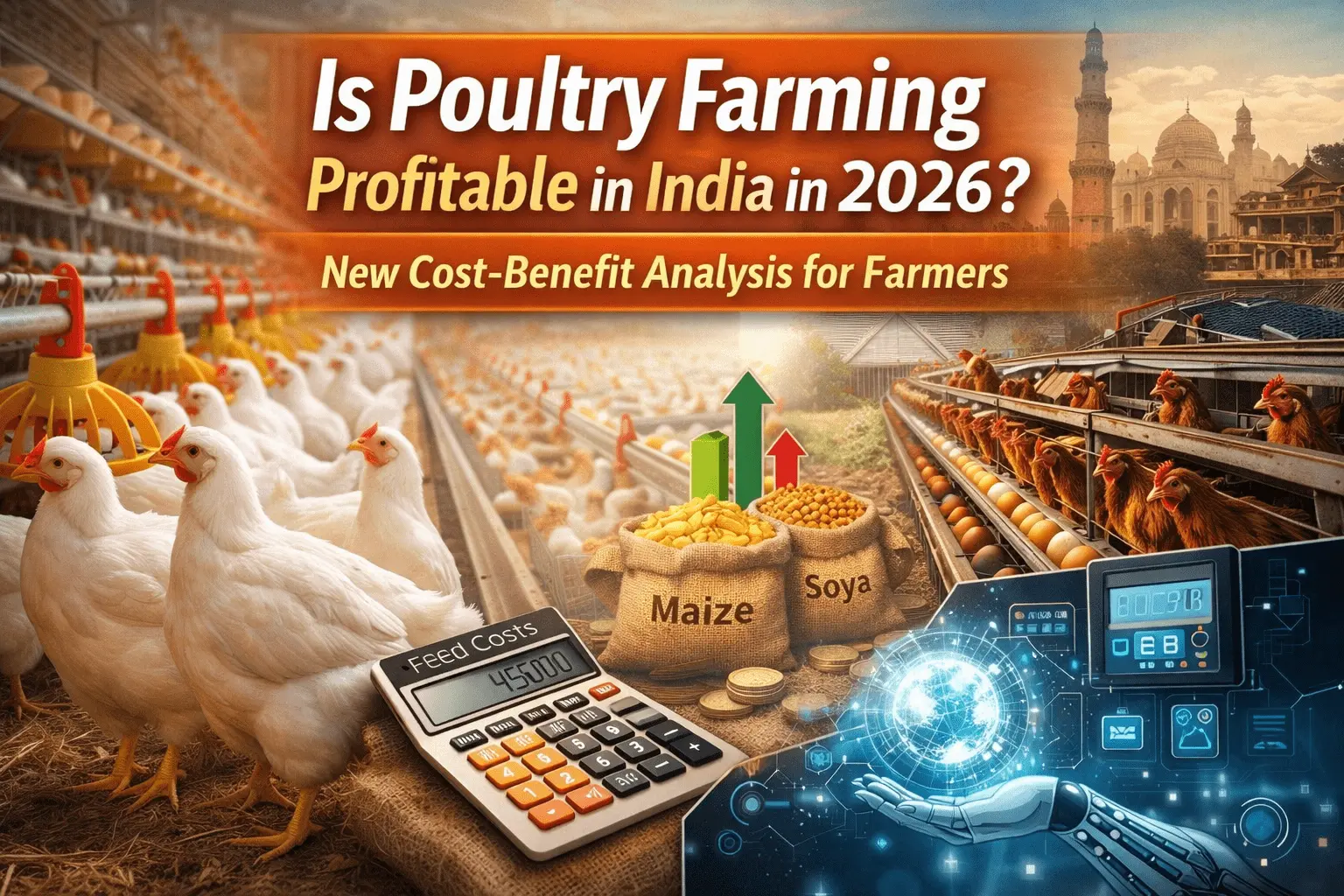
Poultry farming has always been considered one of the most reliable agribusiness options in India. From small backyard units to large commercial farms, lakhs of Indians depend on poultry for their livelihood. But as we move into 2026, a common question is being asked by new and existing farmers alike: Is poultry farming still profitable in India, or have rising costs reduced the scope for earnings?
With feed prices increasing and technology becoming essential, poultry farming in India is no longer a “set-and-forget” business. This article explains the real ground-level situation in India, using practical numbers and clear logic, so new entrepreneurs can make informed decisions.
1. The Big Question in 2026
In 2026, Indian poultry farmers are facing a mixed situation. On one hand, winter demand for eggs and chicken remains strong, especially in urban and semi-urban areas. On the other hand, input costs like feed, electricity, and medicines have gone up, putting pressure on profits.
Industry estimates suggest that global poultry demand has increased by around 2.5%, and India continues to be one of the fastest-growing markets. However, higher maize and soya prices mean that profit margins are tighter than before.
Why should you read this guide?
Because it breaks down exact Indian farm-level costs—chicks, feed, labor, and infrastructure—and compares them with realistic selling prices, helping you understand whether poultry farming makes sense for you in 2026.
2. Market Reality: 2026 Trends Indian Farmers Must Know
Rising Feed Prices: The Biggest Challenge
Feed accounts for nearly 70% of total poultry production cost in India. In 2026, maize and soya prices remain unstable due to weather changes, export demand, and transportation costs.
For Indian farmers, even a ₹1–₹2 increase per kg of feed can significantly reduce monthly profits. This is why feed management and sourcing directly from mills or bulk suppliers has become extremely important.
Egg Price Spikes in Winter
The positive side is demand. During January 2026, egg prices in many Indian mandis rose by 25% to 50%, especially in metro cities and state capitals. Schools, hostels, hotels, and street food vendors increase consumption during winter, pushing prices higher.
However, experienced farmers know that these high prices are seasonal, and planning production according to demand cycles is critical.
Technology Is Now a Necessity
In 2026, automation is no longer optional for Indian poultry farms. Automatic feeders, water lines, temperature control, and digital monitoring help reduce feed wastage and mortality. Farmers who still rely entirely on manual systems often struggle to compete with tech-enabled farms.
3. Detailed Cost Analysis (For a 1,000-Bird Indian Poultry Farm)
Below is an approximate cost structure suitable for Indian conditions. Actual costs may vary by state and scale.
| Expense Item | Estimated Cost (Per 1,000 Birds) | Key Note |
|---|---|---|
| Day-Old Chicks | ₹35,000 – ₹50,000 | Depends on breed & hatchery |
| Feed Cost | ₹1,00,000 – ₹1,25,000 | ~70% of total cost |
| Medicines & Vaccination | ₹8,000 – ₹12,000 | Essential for biosecurity |
| Labor & Utilities | ₹15,000 – ₹25,000 | Power, water, workers |
| Infrastructure | ₹1,50,000+ (One-time) | Shed, feeders, drinkers |
Important: Farmers who control feed wastage and maintain good hygiene usually recover infrastructure costs within a few cycles.
4. Revenue & Benefit Analysis: How Indian Farmers Earn
Direct Sales: Eggs and Broilers
In 2026, average Indian market trends show:
- Egg prices: ₹7–₹8 per egg in many cities
- Broiler prices: ₹90–₹120 per kg (varies by region)
With proper planning, selling during peak demand months can significantly improve returns.
Additional Income: Poultry Manure
Poultry manure is gaining demand as an organic fertilizer, especially among vegetable and fruit farmers. Many Indian poultry farmers earn extra income by selling manure locally, helping offset feed costs.
Realistic Profit Margin in 2026
A well-managed poultry farm in India can earn a net profit margin of 12%–15%, provided:
- Mortality is kept below 5%
- Feed Conversion Ratio (FCR) is well managed
- Disease outbreaks are avoided
5. Challenges & Risks Every Indian Poultry Farmer Faces
Avian Influenza (Bird Flu)
Bird flu remains a serious risk. A single outbreak can stop sales instantly. Strict biosecurity, limited visitor access, and timely vaccination are essential safeguards.
Price Fluctuation After Winter
Egg prices usually fall after winter. Farmers who expand production without planning for this drop often face losses. Storage is not an option, so timing is everything.
Shift Towards Organic and Cage-Free Eggs
Urban consumers in India are slowly moving towards cage-free and organic eggs. While this opens premium markets, it also increases production cost and management complexity.
6. Conclusion: Final Verdict for 2026
So, is poultry farming profitable in India in 2026?
Yes—but only for disciplined and informed farmers.
The business now rewards those who focus on operational efficiency, biosecurity, and data-based decisions. Blind expansion without cost control can quickly lead to losses.
Final Advice for New Entrepreneurs
- Start with a small unit and learn the basics
- Focus on biosecurity from day one
- Monitor Feed Conversion Ratio (FCR) regularly
- Plan production around high-demand seasons
In 2026, poultry farming in India is not just agriculture—it is a business that demands planning, technology, and constant monitoring. Those who adapt will continue to find it profitable, even in a challenging cost environment.
