
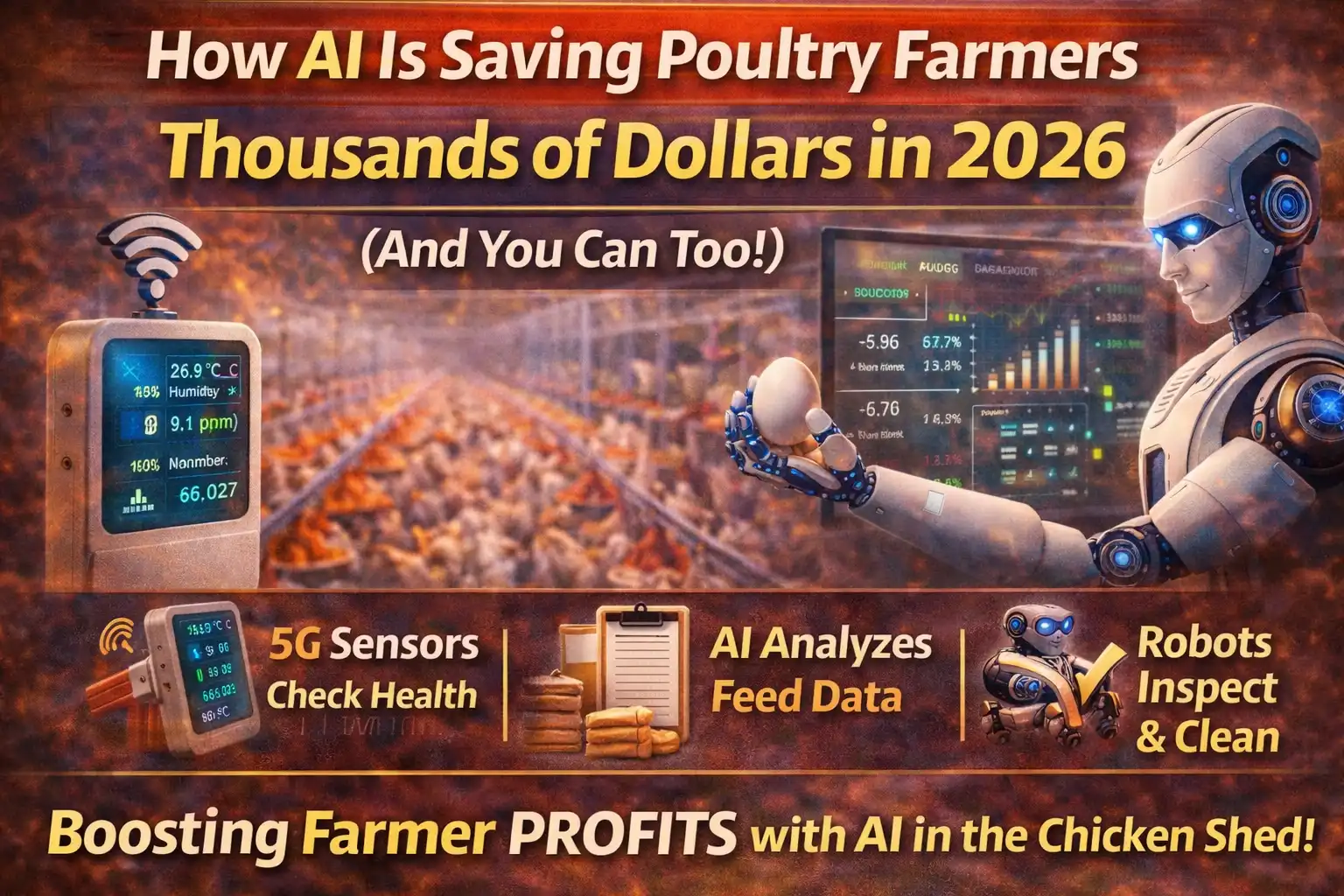
In 2026, Artificial Intelligence is no longer limited to software companies. It’s now working inside poultry sheds, quietly cutting costs, improving bird health, and boosting profits. From smart sensors to AI-driven feed planning, farmers who adopt tech early are already seeing measurable gains.
If you’re a farmer—or a tech geek curious about agri-tech—here’s how AI is changing poultry economics right now.
The Big Shift: AI Has Entered the Chicken Shed
Rising feed costs, labor shortages, and disease risk forced poultry farmers to rethink operations. The result? AI-powered monitoring and automation that replaces guesswork with data.
What’s changed in 2026:
- Cheap sensors + faster connectivity
- Easy-to-use AI tools (no coding needed)
- Real-time decisions instead of weekly reviews
Smart Sensors: 5G Tech That Cuts Mortality by ~20%
Modern poultry farms are deploying 5G-connected IoT sensors that track:
- Temperature & humidity (micro-climate control)
- Ammonia & CO₂ levels (respiratory health)
- Feed and water intake (early disease signals)
Why it matters:
AI models detect abnormal patterns early—often before visible symptoms—allowing farmers to act fast. Early adopters report up to 20% lower mortality and better feed efficiency.
AI Feed Management: Turning Data into Savings
Feed is ~70% of production cost. AI now helps farmers optimize every gram.
How it works:
- Farmers upload feed usage, bird age, and weight data
- AI tools analyze trends and suggest adjustments
- Output: precise feed schedules and ingredient mixes
Many farmers use conversational AI like OpenAI’s ChatGPT or Google Gemini to:
- Compare feed formulations
- Forecast feed demand
- Reduce wastage and overfeeding
Result: Noticeable cost cuts without sacrificing output.
Automation in 2026: Meet the “Robot Inspectors”
Night shifts are going robotic.
New-age farms are testing robot inspectors that:
- Clean aisles and remove waste
- Scan eggs for cracks and dirt
- Patrol sheds at night to reduce stress and human dependency
These robots work 24/7, improve hygiene, and reduce labor costs—especially during peak seasons.
The Math: Is AI Worth the Investment?
Here’s a realistic mid-size farm example:
| Item | Amount (₹) |
|---|---|
| Initial AI setup (sensors + software) | 1.5–2.0 lakh |
| Annual feed & mortality savings | 3.5–5.0 lakh |
| Payback period | ~6–8 months |
| Net margin impact | Strongly positive |
Bottom line: AI doesn’t add cost—it removes inefficiency.
Why Egg Prices Matter to AI Forecasting
AI systems perform best when market prices are live. By integrating daily egg prices, AI can:
- Time sales better
- Decide when to scale production
- Optimize inventory and cash flow
That’s why many farms link their dashboards with todayeggrate.com—to feed real-time price signals into AI forecasts.
Final Takeaway: Poultry Farming Has Gone Smart
In 2026:
- AI is practical, affordable, and proven
- Small and mid-size farmers can compete with large integrators
- Data-driven decisions beat intuition every time
If you want higher margins with lower risk, AI adoption is no longer optional—it’s strategic.
For daily egg rates, market trends, and tech-enabled farm insights, keep following todayeggrate.com.
Smart farms don’t work harder—they work smarter. 🐔🤖📊
