
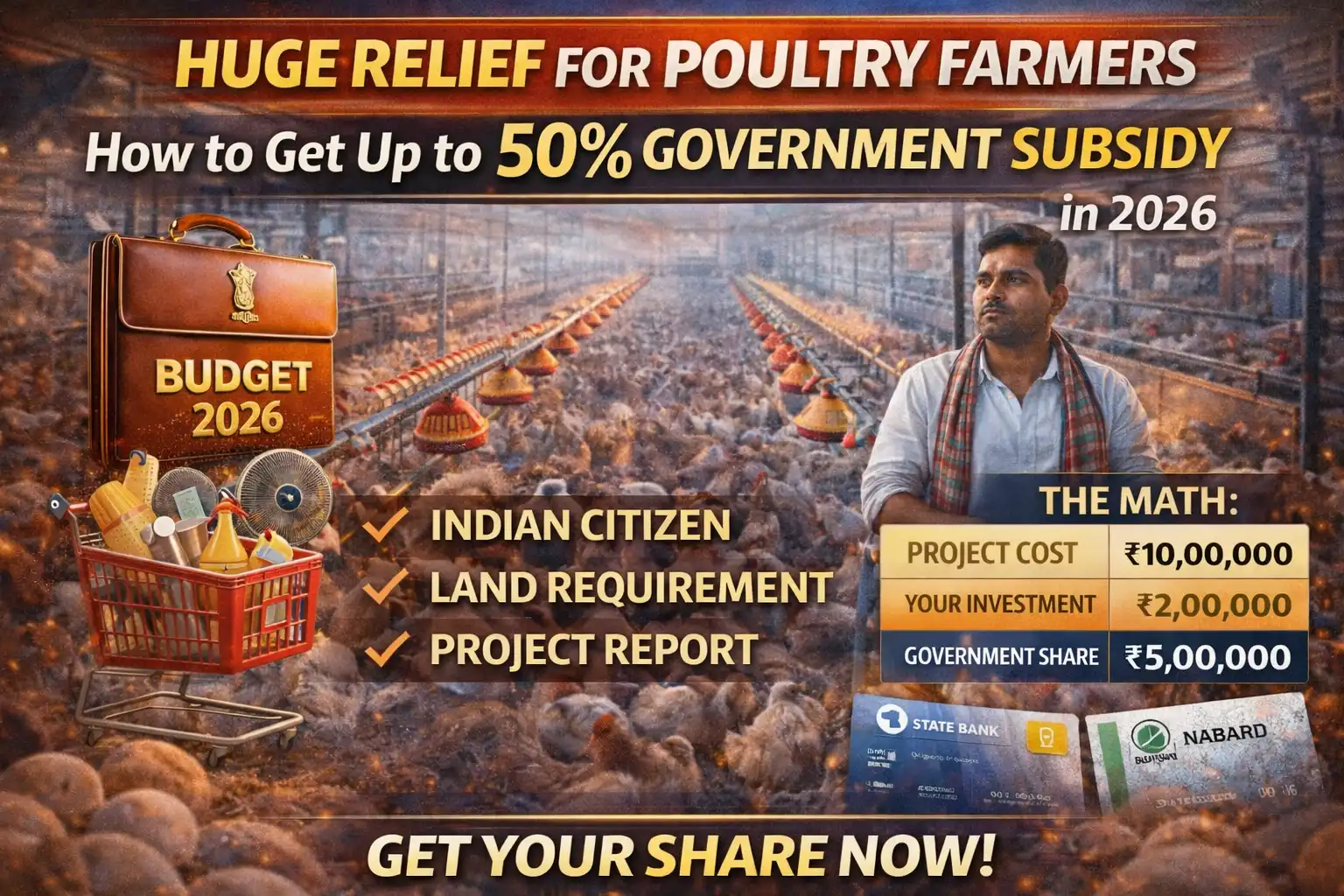
Running a poultry farm in 2026 is no longer cheap. From climate-controlled sheds and automated feeders to bio-security equipment, capital costs have shot up sharply in the last few years.
Recognizing this pressure, the government has stepped in with strong financial support for poultry farmers, making 2026 one of the best years to invest or expand.
If you’re searching for a Government Subsidy for a Poultry Farm in 2026, this guide explains who is eligible, how to apply, and whether the subsidy is really worth it.
Why the Government Is Supporting Poultry Farms in 2026
Poultry is now treated as a high-growth agri-business, not just a backyard activity.
Key reasons for subsidy push:
- Rising demand for affordable protein (eggs & chicken)
- Employment generation in rural areas
- Export potential and value-chain expansion
- Cost pressure from feed, electricity, and infrastructure
That’s why recent policies and Budget 2026 changes focus on reducing the initial investment burden for farmers.
Eligibility Criteria: Who Can Apply for Poultry Subsidy in 2026?
Most central and state poultry schemes follow similar basic rules.
You can usually apply if you meet these conditions:
- Indian citizen with a valid ID (Aadhaar, PAN)
- Minimum land availability (owned or leased, as per scheme)
- Bank account linked with Aadhaar
- Basic project report (DPR) for poultry farm
- First-time entrepreneurs and small farmers are preferred
- SHGs, FPOs, and rural youth are often given priority
Exact conditions may vary slightly by state.
Step-by-Step: How to Apply for Poultry Farm Subsidy (2026)
Here’s the simplified process most farmers follow:
Step 1: Prepare a Project Report
Include:
- Farm capacity (layers/broilers)
- Shed type and equipment
- Total project cost
Step 2: Approach a Bank
Apply for a loan under schemes linked with NABARD or your state’s animal husbandry department.
Step 3: Apply for Subsidy
- Bank forwards your project for subsidy approval
- Subsidy is credit-linked, not paid upfront
Step 4: Implement the Project
- Build sheds, buy equipment
- The bank releases the loan in stages
Step 5: Subsidy Adjustment
- The government share is adjusted against your loan after verification
This makes cash flow easier during the early months.
The Math: How Much Do You Really Pay?
Here’s a simple example to understand the benefit:
| Item | Amount (₹) |
|---|---|
| Total Project Cost | 10,00,000 |
| Government Subsidy (50%) | 5,00,000 |
| Your Own Investment | 2,00,000 |
| Bank Loan | 3,00,000 |
Without a subsidy, the same project would require much higher personal capital and EMI pressure.
Is the Poultry Subsidy Worth the Paperwork?
Short answer: Yes—especially in 2026.
Why:
- Subsidy can cover 30–50% of the capital cost
- Budget 2026 increased allocations for poultry & livestock
- Banks are more willing to finance structured projects
- Long-term profitability improves with lower debt
The paperwork may take time, but the financial relief lasts for years.
Final Verdict: Best Time to Start or Expand a Poultry Farm
If you’re planning to:
- Start a new poultry farm
- Upgrade sheds or equipment
- Enter layer farming for eggs
👉 2026 is one of the most subsidy-friendly years in recent times.
For daily egg price updates, subsidy news, and farmer-focused poultry insights, keep following todayeggrate.com.
Smart farmers don’t just grow birds—they grow with policy support. 🐔📈
