
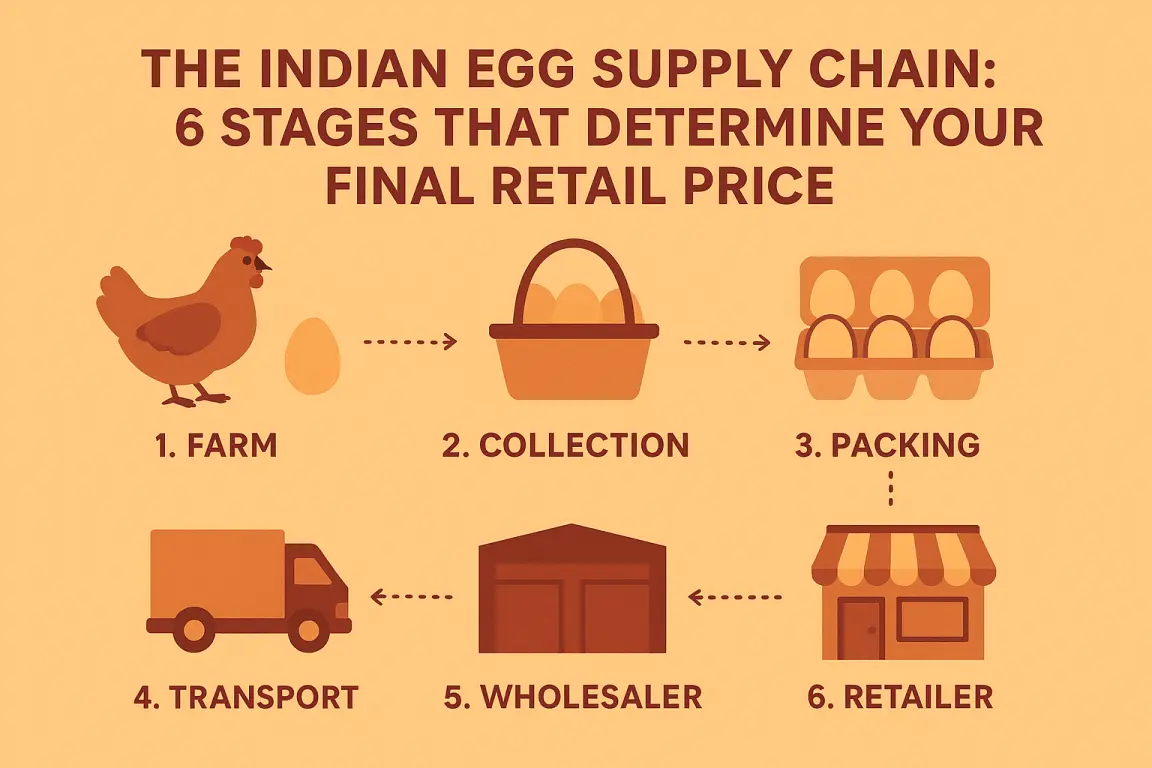
Have you ever wondered why the price you pay for an egg is often double the “Farm Gate Price” announced by the National Egg Coordination Committee (NECC)? The answer lies not on the farm, but on the road.
India’s egg supply chain is a vast, intricate, and often inefficient network. Each kilometer an egg travels and each hand it passes through adds to its final cost, directly impacting what you pay and how fresh the egg is on your plate.
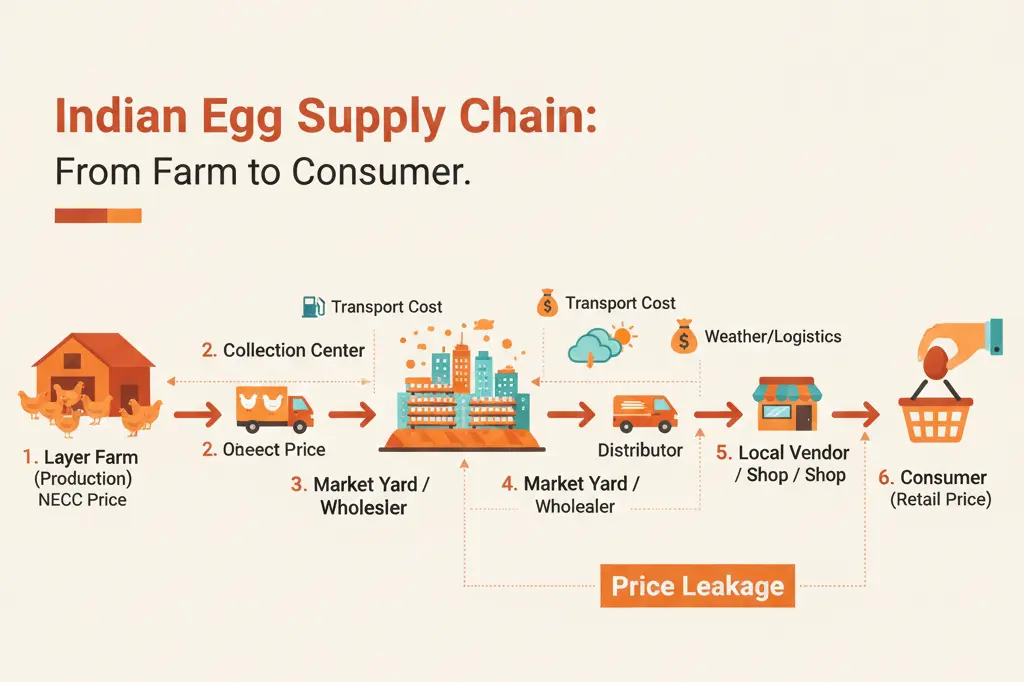
This article maps the 6 key stages of an egg’s journey from the farm to your local vendor, demystifying where the “price leakage” happens and why the final retail price is what it is.
Stage 1: The Layer Farm (The Starting Point)
This is where it all begins.
- The Farm Gate Price: Eggs are laid, checked for cracks, and graded. The daily NECC price serves as a crucial benchmark here, calculated based on prevailing feed (maize, soya), labor, and energy costs.
- Initial Packaging: Eggs are immediately packed into plastic trays (typically 30 eggs) and then into larger crates for bulk handling. This first step is all about production cost.
Stage 2: The Primary Collection Center (The Aggregator)
Small and marginal farmers rarely have the volume to transport directly to far-off cities.
- The Role: Local agents or collectors visit multiple small farms in a region, consolidating their produce.
- Creating Volume: This aggregation is essential to make long-distance transportation economically viable for trucks.
- First Margin: A small commission or fee is added here for the service of collection, basic sorting, and local transport to a larger hub.
Stage 3: The Market Yard / City Wholesaler (The Major Hub)
This is where the first significant price jump often occurs. Eggs from production states (like Andhra Pradesh, Tamil Nadu, Punjab) arrive at massive wholesale markets in consumption cities (like Delhi, Mumbai, Kolkata).
- The Journey: Transportation in non-refrigerated trucks over hundreds of kilometers.
- The Cost of Fuel: Diesel prices directly and heavily impact the cost added at this stage.
- The Wholesaler’s Role: They buy in lakhs (from multiple aggregators) and sell in thousands. They absorb the risk of price fluctuations, breakage, and spoilage during transit.
- Price Setting: The NECC rate is the base, but the final wholesale price is dictated by city-specific demand, local taxes (like mandi tax), and the wholesaler’s own cost-to-carry.
Stage 4 & 5: Sub-Wholesalers & Distributors (The Local Network)
The eggs now need to reach every neighborhood.
- The Fragmented Middle: Sub-wholesalers buy from the main city wholesaler and supply to distributors, who then cater to specific zones or large retail chains.
- Added Logistics: Costs for smaller vehicles, repeated handling, and local storage (still largely without cold chains) are added.
- The “Price Leakage”: This is often the most fragmented part of the chain. Multiple small intermediaries, each adding a margin for their service and risk, can inflate the cost without adding proportional value. The lack of organized, cold-chain logistics makes this stage inefficient and costly.
Stage 6: The Retail Vendor (Your Local Shop)
The final link in the chain.
- Channels: This includes your neighborhood kirana store, the egg stall at the market, pushcart vendors, and modern supermarkets.
- The Final Margin: The retailer adds a margin to cover their shop rent, electricity, staff wages, and most critically, wastage from breakage and spoilage. A supermarket with AC may charge more than a pushcart vendor due to higher overheads.
- The Price You Pay: This is the sum total: Farm Cost + Transportation (Fuel) + All Intermediary Margins + Retail Overhead + Taxes.
Conclusion: The Efficiency Challenge
The significant gap between the farm gate price and the retail price is a direct result of long-distance transportation costs, multiple intermediary margins, and the critical lack of cold-chain infrastructure in India’s vast and warm geography.
The Future: Improved cold storage at hubs, better packaging, and direct procurement models by large retailers or farmer-producer organizations (FPOs) can streamline this chain. This would reduce spoilage, improve freshness, and potentially lower consumer prices.
Knowledge is Power. Whether you’re a retailer negotiating with a distributor or a consumer wanting value, understanding this journey is key.
Before your next purchase, see the full picture. Check and compare the live farm-gate, wholesale, and retail egg prices in your city on TodayEggRate.com to make the most informed decision.
